




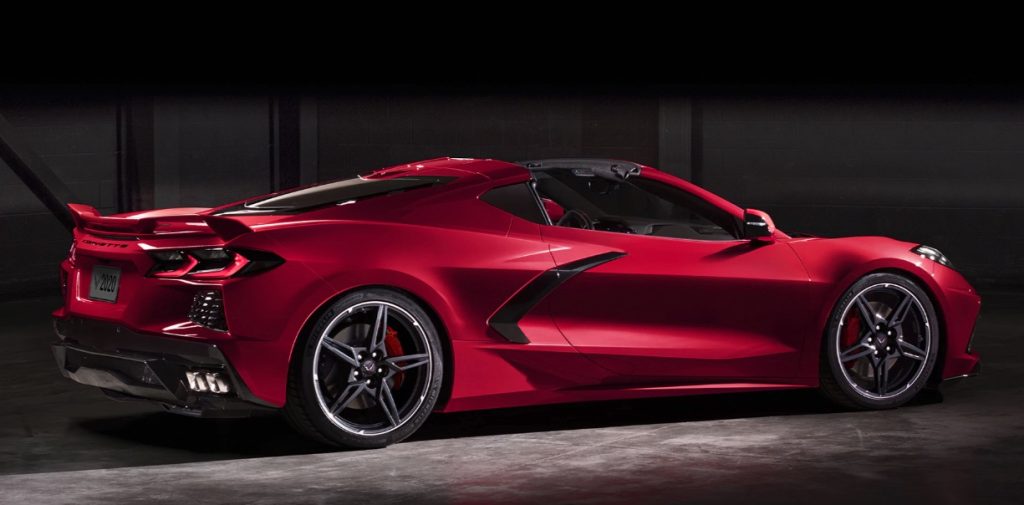
Last month, Chevrolet introduced the world to the next big thing in performance: the eighth-generation 2020 Chevrolet Corvette. The C8 ‘Vette is notable for a lot of reasons, but the biggest one is the location of the engine: unlike every production Corvette since all the way back to 1953, the 2020 Corvette will feature a mid-mounted engine, with a high-horsepower V8 stashed like a jewel under a glass engine cover just behind the two front seats.
In addition to providing the 2020 Corvette with unparalleled balance and handling, the mid-engine configuration lets the C8 Stingray rocket from zero to 60 in around three seconds! That’s fast! And with a starting price under $60,000, it’s fairly affordable too, an an outright bargain in the overheated world of supercars.
The road to the mid-engined Corvette was a long one, but Chevrolet has been hinting at aft power through their Corvette concept cars for decades. Read on for four Chevy concept Corvettes over the years that helped the Bowtie Brand work out the engineering and design architecture of the most revolutionary Corvette in over 65 years!
1960-61: CERV II
In the history of Corvette, few names loom larger than Zora Arkus-Duntov, the engineering wizard who took ‘Vette into the modern age of performance as Chevrolet’s first high-performance director. In order to work out design problems, Chevrolet under Arkus-Duntov built test mules named CERV I and II, with the acronym standing for “Chevrolet Engineering Research Vehicle.” Both CERV test mules were mid-engine, with powerful aluminum-block Chevy small-block engines mounted just behind the front seats and lightweight fiberglass bodies. Though Arkus-Duntov wanted to develop CERV II as a racing prototype to take on Ford’s mighty GT40, changes in GM leadership put the project on ice. The CERV I and II, however, did give engineers an important early starting point for mid-engine ‘Vette development.
1968: Chevrolet XP-880 (Astro II)
Around the same time Arkus-Duntov’s promising CERV II program was being shut down by GM brass, Corvette designer Larry Shinoda — who was key to the design of the groundbreaking 1963 Corvette Stingray — penned an equally-groundbreaking new design, known in-house as the Chevrolet XP-880. Later put on car show tours as the Astro II concept car, the graceful sports car drew heavily from the sinuous shapes being produced in Europe by makers such as Ferrari and Lamborghini. Like those vehicles, the XP-880 was also mid-engine. Mounted just behind the front seats of the XP-880 was a thundering 7.0-liter 427 Chevrolet big block, with power sent to the rear wheels through a two-speed automatic transaxle from a 1963 Pontiac Tempest. The resulting car was a bullet, with test drivers achieving 1G cornering on the skidpad, in spite of the poor tire technology of the 1960s. Though the project was promising, it was eventually shelved, and became just another mid-engine Corvette what-could-have-been.
1970: XP-882
Another excruciatingly beautiful mid-engine Corvette concept car was introduced the year after the XP-880: the XP-882. Revealed at the New York Auto Show in April 1970, the XP-882 was mobbed by adoring crowds thanks to its sleek, futuristic looks, which recall the swoopy De Tomaso Pantera supercar. Low slung and wedge-shaped, with a beautiful louvered rear window that recalled the v-shaped rear glass of the beloved 1963-65 Corvette Stingray, the drop-dead gorgeous XP-882 was equally exciting to the Chevrolet sales department. The car looked to be on a fast-track to full-scale production in the 1970s, but Chevrolet General Manager John DeLorean — who would later go on to fame and infamy as the man behind the DeLorean sports car — killed the project because it would have required more expensive tooling, instead deciding to focus on a Corvette that shared the chassis with the Camaro. Though several of the design elements from the XP-882 were later adapted for the Camaro and production Corvette, the prototype is another mid-engine false start for Corvette.
1986: Corvette Indy
With wedge-shaped fourth-generation Chevy Corvette all-new for 1983, Chevrolet was looking to give the motoring public a look at what was next for the Corvettes of the future, and it just doesn’t get much more futuristic than the Corvette Indy concept car, which debuted at the 1986 Detroit Auto Show. Cutting edge in every way for its day, the Corvette Indy went for a slippery, curvaceous, Formula 1-inspired shape then preferred by European supercar builders, including the legendary Jaguar XJ220. Powering the Indy was a small-displacement powerplant mounted mid-ship: a high-revving 2.65-liter twin-turbo V8 delivering more than 600 horsepower at staggeringly high RPMS. The construction of the car hinted at future materials choices, too, with the body composed of then-rare Kevlar and carbon fiber, with a monocoque chassis inspired by high-end racecars and an all-wheel drive, four-wheel-steered suspension by racing legend Lotus. Though the concept was developed into the CERV III and was rumored to have almost made it to the production line, the car was eventually shelved and the world would have to wait another 30-plus years for the first mid-engine Corvette.
We’re beyond stoked here at McLarty Daniel Chevrolet of Springdale for the arrival of the 2020 Corvette this fall! We’re your Northwest Arkansas Corvette superstore! Want to buy a 2020 Corvette in Northwest Arkansas? Then stop in today, talk to one of our friendly finance professionals, and get pre-approved to own one of the first models of the groundbreaking, revolutionary, long-sought mid-engine 2020 Corvette!
Connect with us


- April 2025
- March 2025
- February 2025
- January 2025
- September 2024
- August 2024
- July 2024
- April 2024
- March 2024
- February 2024
- October 2023
- September 2023
- August 2023
- July 2023
- June 2023
- May 2023
- April 2023
- June 2022
- May 2022
- January 2022
- October 2021
- September 2021
- August 2021
- July 2021
- June 2021
- May 2021
- April 2021
- March 2021
- February 2021
- January 2021
- December 2020
- October 2020
- September 2020
- August 2020
- July 2020
- June 2020
- May 2020
- March 2020
- February 2020
- January 2020
- December 2019
- November 2019
- October 2019
- September 2019
- August 2019
- July 2019